CHAPTER 20
How Every Ending Is a Beautiful Beginning
One topic that kept coming up when I was researching this book was how to know when the issues you are facing in a relationship are something that you can resolve versus something that you need to accept.
When is overthinking, frustration, and bickering normal, and when is it a sign that something is broken? When should I just Let Them be versus admitting the painful truth that this relationship is no longer working for me?
Having been married for almost 30 years, I can tell you that mutual give and take and compromise are critical to a successful relationship. No one is perfect, no relationship is perfect, and every relationship changes with time.
In a long-term partnership, there will be periods in your relationship that are amazing, and there will be times that are extremely difficult. But every couple that has made a relationship work has had two important things present:
First, they both wanted the relationship to work. And they were both willing to do the work to make it better. Second, the issues that created problems did not require either person to give up their dreams or compromise their values.
So if you’re sitting here wondering if you’re in the right relationship, that’s a good thing because it means you want to be with somebody that is going to bring out the best in you, and who will work with you to create a good life.
One of the hardest things that I’ve experienced is being with someone who is a really good person, and knowing deep down that they are not the right person for me.
Or, in a couple cases, being with a really good person and knowing that I was in the wrong place mentally and not the right person for them—in fact, I had no business being in a relationship at all. (I am thinking about the apologies I’ve made to my college and law school boyfriends. I was in a horrible place mentally in my 20s, and boy did I behave in ways I deeply regret.)
Admitting that a relationship is not working is one of the hardest things in the world to do, especially if you’re in love with them. Often, it’s not that obvious what the issue is. Deep down you just know that underneath the day-to-day, and the familiar routine together, something feels off.
Love the Person, Not Their Potential
Any time you find yourself questioning whether or not this is the right relationship for you, ask yourself: Can you accept this person exactly as they are, and exactly where they are, and still love them?
That means, do you truly love your boyfriend, girlfriend, wife, husband, or partner for who they are right now? Or do you love who they once were, or who you wish they would become?
Even if there are specific things that bother you, in the end they might not be deal breakers. They may be things you have to learn to accept, and that’s just work you’re going to have to do to make this relationship thrive.
Let Them.
For example, maybe you can’t stand that they’ve started vaping, they don’t take care of themselves, they are such a slob it is driving you crazy, they don’t plan anything, the sex is boring when it happens, they never want to do anything, or they are not interested in moving to a new city or traveling to a new country on vacation.
Can you still love them despite all these things? Because, the reality of it is. . . they may never change. And here is the other thing, they probably won’t.
Remember, one of the fundamental takeaways from this book: People only do what they feel like doing. Yes, you can influence them. But if you keep wanting them to change, and they don’t, it not only weakens your love. It creates resentment.
What I have noticed with couples is that the longer you are together, the more you want your partner to be like you. That’s not fair. So be honest with yourself. Do you just want them to be just like you, or is it that one of your fundamental needs in the relationship is not being met? This is very important because based on the laws of human nature you should assume the person is never going to change.
Let Them be. Instead of sitting there silently resenting them or criticizing them behind their back, be the loving and mature person in the relationship. Either stop trying to make them like you, and accept them as they are, or have the productive and loving conversation about what you need, and why this is bothering you.
Maybe they don’t even know you’re upset by it, or they don’t know how you feel about the issue, or they don’t know how important it is to you, or they do know, but you have just created a standoff.
So before you spend another year overthinking and wondering if this is your person, have the conversation, apply the science, and then sit back and wait. You know how to do this using the ABC Loop and the power of your influence:
A: APOLOGIZE, then ASK open-ended questions.
B: BACK OFF, and observe their BEHAVIOR.
C: CELEBRATE progress while you continue to model the CHANGE.
When you use Let Me to influence someone else, do it with the hope that they change, because you love them and want something better for them, and you want the relationship to work and this matters to you. But don’t ever do it with the expectation that they must change.
Because even when you use science to influence someone else, they are still their own person and are in control of what they choose to think, say, and do. Give it at least three months without any negative energy, while you keep modeling the positive change and celebrating anything you see.
Let Them be.
Why three months? It’s plenty of time for your energy to shift and for the other person to suddenly feel inspired to make the change and believe it was their idea.
Remember the example of my friend and her husband. This issue of his health had been bothering her for a while, and even though she loves her husband, it’s made her wonder if he is the right person for her? Can she be married to someone who doesn’t take care of themselves?
So she’s been using the Let Them Theory to answer this question. She is letting him be, and meanwhile, she’s been going for a walk every morning, she’s been positive and happy, she’s been complimenting him and hugging him, and she’s been very affectionate whenever he exercises.
And now she has to wait. One of the hardest parts about waiting, and just letting them be, is that moment when your loved ones complain about the natural consequences of their behavior.
Like how much money they have spent on vaping. (But they are still vaping). Or how much they hate their job. (But they haven’t looked for a new one). Or how depressed they feel. (But they refuse to go to therapy.)
My friend shared that her husband was complaining the other day that he was so winded during pickleball that he had to step out of the game with his friends.
When that happens, your tendency is to want to reassure someone. Don’t do it. Let their complaint hang in the air. Don’t respond.
Let Them sit with it. Say nothing. Let Them experience their feelings. Let the silence do the work for you. Let Them feel the consequences of their actions. Let Them.
And then, Let Me use science. Ask them an open-ended question. “It sounds like it bothers you?” “Is there anything you want to do about it?”
As you’ve already learned from Dr. K, these open-ended questions are what researchers call motivational interviewing. It makes your partner reflect on the conflict between what they truly want to change in their life and their current behavior, and what they don’t.
The Deal Breaker Decision
But. . . what happens if you follow the ABC Loop, and you wait patiently for three months, and nothing changes?
It means that your partner doesn’t feel like changing. Their behavior tells you that. So, you have a choice. Because you always have power if you focus on your response. You’ve followed ABC. Now it’s time for you to move to the next two parts: D and E.
THE ABC (DE) LOOP
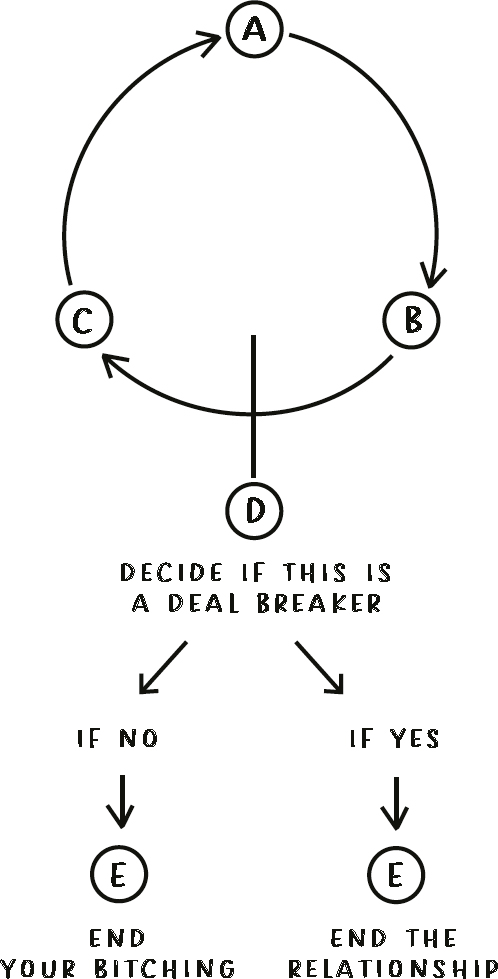
Step D: DECIDE if this is a DEAL BREAKER or not.
If after three months, the person hasn’t changed or hasn’t tried to change, assume they aren’t going to. And, I’m sorry that I have to be the one to tell you this, but they’re not ready. They don’t want to do it. Doing it for you is not enough. It’s not a priority of theirs, or maybe there is something deeper going on, and they are not capable of changing.
Or maybe they are just the way they are, and that’s okay. Their behavior is their answer and they have made it clear.
Let Them. Not everyone wants to change. Sometimes in life, the most loving thing you can do is to stop fixing, start accepting, be more loving, and focus on what you can control.
And what you can control is choosing to love someone as they are.
I know it’s not fair. I know it’s disappointing. I know it’s frustrating and sometimes even devastating that someone won’t change for you. Let Them be.
Now it’s time for the second part of the theory, Let Me. It’s time to decide if this is a deal breaker for YOU. Because remember, you always get to choose who and how you love.
You can choose whether or not this is a deal breaker. A deal breaker is something you can’t live with for the rest of your life. Here’s how you figure that out.
Ask yourself: Could you be with this person for the rest of your life if they never, ever change?
Whether the answer is yes or no, move to Step E because something needs to end for this relationship to get better.
Step E: END your bitching or END the relationship.
You are at the point where they are not changing. You are in a standoff on the issue and you can either live with this or you can’t. You have to choose to end your bitching or end the relationship.
Can you stop complaining about this issue, for real? Can you stop griping to yourself, holding it over their head, and acting in a passive-aggressive way and complaining to your friends?
If you’re going to choose them, you owe it to them and to yourself to choose them exactly as they are. Take my marriage. My ADHD drives Chris crazy, and I understand why. I am a disaster a lot of the time.
I’ll leave my dishes in the sink or stacked on my desk, I constantly misplace my keys, my stuff is all over my side of the bathroom sink, and anytime we are going somewhere I’m late.
Chris is usually sitting in the car patiently waiting for me while I run around the house like a lunatic looking for something I can’t find. . . and this is just the tip of the disorganized iceberg that is Mel Robbins.
Over the years, Chris has sat me down. We’ve had countless conversations about it. How I leave dirty tissues on the counter and forget to throw them in the trash. (“It’s disgusting, Mel.”) Or how frustrated he gets when I am distracted and scrolling on Instagram. (“Are you even listening to me right now?”)
And I know that my behavior makes him feel like I don’t respect his time or care how my chaos impacts him.
I have tried to change. I want to change. I work on it. And it still hasn’t happened. I am late. I lose everything. I make messes around the house and don’t clean them up. I hate this about myself. I wish I could snap my fingers and change this aspect of who I am.
Chris is on time. Organized. Calm. Predictable. Always has been. Always will be. Chris would like me to be more like him. His life would be easier. He’d feel more supported and respected by me.
But relationships are about learning how to love someone for who they are, not for who you wish they could be. When you start using the Let Them Theory, you’ll learn to see other people as they are, and then you’ll see that it’s up to you to figure out what you can accept and what you can’t. That’s how you hold on to your power. It’s always in your response.
At the same time, as you let go of the surface-level stuff that is never going to change, you’ll probably start to see the deeper things you have been taking for granted. For instance, while there is a lot about Chris that used to annoy me, one of the things I value most about my husband is how kindhearted, dependable, and peaceful he is. I never knew I “needed” that in a relationship. He, on the other hand, values my wild enthusiasm, fierce loyalty, and sense of humor.
It’s why, as much as my behavior frustrates him, it is not a deal breaker. Chris has decided that everything else that I provide as his partner trounces the annoyances created by my ADHD.
Chris has accepted the fact that I will be like this for the rest of my life. And learned to both laugh, and live with it. Let Mel be. . . Mel.
That’s why the Let Them Theory has made my marriage stronger. It’s taught me how to accept Chris for who he is, and stop complaining about who he isn’t. . . and vice versa.
You’ll discover the exact same clarity in your own relationships. For my friend and her husband, this may mean that when she wakes up to hit the Peloton in the basement, she lets him sleep in. And that means being super quiet when she gets dressed, instead of slamming the bedroom door like she used to.
I share this example because loving someone as they are goes beyond ending your bitching. You demonstrate through your behavior that you do love them as they are. You lead with kindness and consideration.
Are You Actually Compatible with Your Partner?
Earlier, I asked you the question: Could you be with this person for the rest of your life if they never, ever change?
And what if your answer is: “I don’t know” or “no?”
If you can’t truly end your bitching, then you can’t accept the other person and love them as they are.
That’s not a very kind and loving thing to do. And if you can’t stop slamming the door in the morning, or being passive-aggressive when they are running late yet again, that’s not kind either.
Whether or not you end a relationship is a deeply personal decision that only you can make. In the case of my friend and her spouse, it’s not a hard call. His unhealthy habits are not a deal breaker. Not even close. She loves him.
She knows that to make the relationship work, she has to work harder at accepting him and changing how she shows up in the relationship. She needs to bring more compassion and kindness to their dynamic. She can keep trying to influence him, but the expectations have to go, along with any complaining. This is about her, not about him.
And because he’s not changing who he is, she needs to change who she has been in order for this relationship to be better.
But what most people are struggling with when they ask questions about using the Let Them Theory to determine whether they are with the right person are issues of compatibility. There’s a difference between being committed to someone, and being compatible with them.
It is very common to fall in love with someone and experience what feels like the most incredible relationship of your entire life—and then over time the two of you start to grow in different directions, want different things, or realize that you’ve become different people.
This is incredibly hard when it happens, because you haven’t fallen out of love. You just don’t quite fit like you used to. I said that two things are required to make a relationship go the distance:
- Both people want the relationship to work and are both willing to work on it to make it better.
- The issues that create problems do not require either person to give up their dreams or compromise their values.
You may be in a situation where you both want the relationship to work, and you’re both willing to do the work. When there’s a problem with compatibility, no matter how hard you work at the relationship, there’s a high chance it still might not work.
It’s one of the saddest and hardest things to come to terms with when it happens, and it’s a deeply personal choice.
For example, let’s say you’re in love with and committed to someone who is British and wants to move back home to London, but you’ve always envisioned staying close to your family in Atlanta.
Or another example that comes up a lot: One of you wants children, and the other doesn’t.
You may talk about it. You may fight about it. You understand the reason why your partner wants to move back home to Europe and they understand why you don’t. You’ve discussed the pros and cons of having children but never seem to come to agreement on your future. You’ve gone around and around on the topic. In the past, you have said, “We don’t need to decide this now.”
But now has come, and you’re at an impasse.
They want to move. You don’t.
You want children. They don’t.
You’re committed to each other, absolutely. . . but you might not be compatible right now.
How do you know this is truly a deal breaker?
Here’s how you figure that out. Let’s take the situation where you are in love with someone who has always wanted to move back home to London. And you have always envisioned being close to your family in the United States.
You ask yourself: Will you regret breaking up with them more than moving to London with them? If you agree to move, will you resent your partner if you choose to leave your family and friends behind?
Both choices come with heartbreak.
One requires you to give up on a dream you’ve had about living close to your family. The other requires you to leave the person who has been, until now, the love of your life.
And by the way, your partner is facing the exact same heartbreak because they won’t compromise either. Your partner is not changing. They are moving to London. With or without you. Let Them.
And now, Let Me make a choice. Am I willing to compromise to be in this relationship?
The fact is, 69 percent of the problems in your relationship are not resolvable. This statistic comes from 40 years of scientific research conducted by Drs. John and Julie Gottman, the most famous relationship researchers on the planet (who also happen to be married).
They’ve found that the #1 issue that couples fight about is things that will never change: Like how someone runs late, or isn’t as ambitious as you would like, or they spend every weekend in front of the TV, or their hobbies are different from yours, or they are messy, or they are a homebody, or they have different political opinions.
These are all examples of the 69 percent of the problems in your relationship that are not resolvable. That’s why it is on you to figure out what you value at the deepest level. Is this something you can compromise on if your partner won’t?
For some people, moving wouldn’t be a big deal. They’d jump at the chance to move overseas with the love of their life.
Dr. John Gottman’s research says that if you are constantly fighting about the same stuff and going around and around, it’s probably because of a profound difference between your and your partner’s personalities and your deepest hopes and dreams.
In other words, you value different things, and you have a different vision for how you want to live day-to-day and what you want to experience in your life. According to Dr. Gottman, almost all gridlock in your relationship comes from “unfulfilled dreams.”
Take the couple fighting about moving to London, or the couple in disagreement over having kids. These are big issues. That’s why you can’t let it go. It’s tied to a deeper vision that you have about your life. It’s a very personal decision that you’re going to need to make.
Moving to London seems like something that is worthy of compromising on. But if you’ve always wanted kids, you’re going to regret wasting a decade with someone only to wake up in your mid-40s and realize this was something you truly wanted—and that now it’s not going to happen.
Ask yourself, is this going to require me to give up on a dream? Because according to the Gottmans, if it does, that’s a problem.
Is There Someone Better?
I’ve also noticed in my research that there are a lot of you in long-term committed relationships who wonder: Is there someone better out there?
The answer is, you’ll never know.
I personally believe this worry is something that dating culture, social media, and romantic comedies have put into your head. There is no perfect person. Everyone has past issues. Everyone has baggage. And the older you get, the more baggage you have.
Most people haven’t dealt with it. Only you know whether you don’t appreciate what’s right in front of you, or if you see everything in your life as half empty. You may think the grass is always greener somewhere else.
The fact is, the grass is greener where you water it.
That brings me back to the two things that are required to make a long-term relationship work:
- Both people want the relationship to work and are both willing to work on it to make it better.
- The issues that create problems do not require either person to give up their dreams or compromise their values.
At some point, you just have to choose. And that might mean choosing what is right in front of you.
As someone who has been married almost 30 years, I assure you every single couple has faced some really dark and scary times in their relationships. And for the couples who chose to lean in and work together through their issues, struggles, and challenges, not a single one of them regrets it.
But I know a lot of people who have gotten divorced and have a nagging regret that they wish they had worked a little harder to make it work and had the courage to face their issues sooner.
Maybe if they would have had the hard conversations and gone to therapy, things would have turned out differently. Because, even if it didn’t end up keeping them together, it would have made the process of breaking up—and the aftermath of separating with kids involved—a hell of a lot better.
Ending a relationship is a very personal and difficult choice, especially when you wish it would work. It might mean choosing to believe in that deep intuition inside of you that something about this just doesn’t quite fit.
You know it, you’ve just been terrified to admit it to yourself. Sometimes you have to end things before they end you. If you know what your dreams are in life, you deserve and need relationships that support you in achieving them. If you stay with someone who doesn’t share the same hopes and dreams that you have. It will make you both miserable.
And look, it’s easy for me to write that in a book. And it’s easy for me to say, Let Them go. But there is nothing easy about breaking up with someone you still love.
That’s when more than ever, you’re going to be grateful that you have the Let Them Theory to help you get through it.
Surviving Heartbreak
I want to speak directly to you or someone you love who is going through heartbreak.
This will be one of the hardest things you ever experience. And you will get through this.
The worst thing someone can say to you when a relationship has just ended is that you should focus on “loving yourself.” That is the world’s worst advice, because when you’re going through heartbreak, you often hate yourself.
You question everything. You wonder if you’ll ever find love again. You want your old life and you wish you could go back to the way things were. You want what you used to have. It feels like your heart is shattering, because it is.
What you’re feeling is grief. The life you thought you were going to live has died. Just like the experience of losing a loved one, when you go through heartbreak, you will experience all the same stages of grief. And it’s going to consume you. For days, and weeks, even months, you’ll think of the person nonstop.
You’ll have to resist the urge all day, every day, to text, or call, or listen to their voice memos, or look at the photos, or check their location, or watch their stories online.
I was speaking to my therapist, Anne, about this, and she explained that:
It hurts so deeply because everything about them is intertwined in your nervous system. They have been a part of you and you have been a part of them for a long time. It is why you can still feel their presence and you can hear their voice. You are so used to talking to them every day, and so you naturally want to reach out. Yes, you miss them but your nervous system always misses them and the ways in which they’ve become intertwined with your experience of life. This is normal.
She was explaining the neurological, physiological, and neurochemical aspect of what it feels like to experience heartbreak. As you walk down the street, or you drive in your car, you’ll imagine that they are there next to you. As you have a thought, you can almost hear what they would say back to you. If something good happens, you’ll feel yourself wanting to share it with them. If something changes in your family, you’ll wish you could tell them.
It’s not just your heart that is breaking, it’s all of these patterns in your life. It’s the circuitry in your body. It’s your nervous system. It’s the thoughts in your mind. It’s the images in your heart. It’s the songs you used to listen to. When you get dressed for work, when you climb into bed at the end of the day and wake up alone in the morning, they will be on your mind.
You’ll live in fear and in hope of bumping into them. You’ll watch their life play out in pictures from far away. You’ll be terrified of the day that you learn they’ve met someone else. The hardest part about a breakup is that you have to go through it.
There is no avoiding it. You experience it in every cell of your body because you must unlearn what it was like to be with them, and learn how to live your life again without them. This is why so many people hold on for so long.
Let Them will not make this easy. Let Them will not remove the pain. My therapist Anne has a rule of thumb when it comes to heartbreak. No contact for 30 days. The reason is that any contact at all—seeing a photo, hearing their voice—will activate all the old patterns in your nervous system, and will really force you to take a step back in your process of unlearning life with this person.
This is the hard part. And you’re going to be in the thick of it for at least three months. That is how long the research says it takes to grieve a breakup before you’ll start to feel a little better.
By the 11-week mark, 71 percent of people feel better. I offer that as a benchmark to give you some comfort that, yes, it will get better. It may get better in 11 days. It may get better in 11 weeks. It may take a little longer. But it will get better.
The Let Them Theory will help you move through this, learn from it, and come through it stronger and more connected to yourself and what you want and deserve in your life. But, while you’re in this first part, you just need to allow yourself to be in it. Let Me.
Let Me grieve. Let Me cry in my bed for days. Let Me tell the story over and over of how it ended. Let Me resist reaching out. Let Me be in a depressive state.
All this sadness is a mentally healthy response to heartbreak. And when you’re ready, there are a couple of things that, based on the research, will help you accept that the relationship is over and that it’s time for you to pick up the pieces of your life and move forward.
Here are a few recommendations for how you can get started on settling your nervous system and moving through this breakup in a healthier way—because it is not time that heals. It is what you do with that time that matters:
1. Remove all environmental triggers.
Take every visible reminder—trinkets, shirts, pictures—and get them out of sight. The patterns of this person are so hardwired in your body and mind that simply seeing things that remind you of them keeps you from moving forward. You don’t need to burn things. You can just put them in a box and come back to them when you have time, space, and distance from all this emotion.
2. Give your bedroom a small makeover.
Chances are, you spent a lot of time together in your bedroom. Giving your bedroom a refresh really helps signal that a new chapter is beginning. Paint a wall or get that cool removable wallpaper. Get new sheets and a new comforter. Move your furniture around. It really helps.
3. Reach out to friends, siblings, cousins, and co-workers.
There is an empty space that this person left that needs to be filled. You need support, so ask for it. There is nothing to be embarrassed about. Everyone has gone through a breakup and understands how horrible it can be. Ask people to check in on you over the next few months and invite you to go for a walk or have dinner so you get out of your house.
4. Fill your calendar.
Look up events in your area and buy tickets so you’re committed to go see an exhibit or go see a friend out of town. Reach out to friends and make plans so that you don’t see an empty calendar, but you are experiencing a busy one. The distraction really helps. Nothing is worse for a breakup than an idle mind. If you don’t have things to keep you busy, you will busy yourself by thinking about them.
5. Pick a challenge you have always wanted to do.
Whether it’s a mountain you’ve wanted to climb, a triathlon you never had time to train for, a class you’ve always wanted to take, or even learning the guitar, this is the perfect time. Choose this challenge for yourself so that you are doing something for yourself that you are proud of. There is no better feeling.
6. Keep asking yourself this question.
If you knew the love of your life was around the corner and this breakup was bringing you one step closer to meeting them, how would you spend your nights and weekends while you are single?
One of the biggest fears when people go through a breakup is they will be alone forever and never find someone as good as the person that just walked out the door. That’s not true, and being intentional about how you want to spend your time being single signals to your brain that you actually do believe that you won’t be single forever—and that you better make the best out of this time right now.
One other thing: Don’t do a revenge diet.
It’s a huge mistake to use a heartbreak as an excuse to lose weight or get jacked at the gym or somehow make yourself more attractive with the hope of winning your ex back or rubbing it in their face as you get hot. Don’t do that. It means you are still chasing your ex and they are still very much part of your day-to-day motivation.
If you want to go to the gym and get back into shape for yourself, fantastic. If you want to take care of yourself and prioritize healthier habits, amazing. But don’t do it for them. Do it for you.
Most of all. . . give it time.
Time doesn’t heal all wounds. What you do with your time does. No matter how busy you get, or how much better you start to feel, it will take time to process everything that happened. Let it take time. . . because it will take time. Often, it takes a LOT of time. But if you keep waking up every day and taking a step forward, one of these days you’re going to wake up and realize that you’re not only feeling better—you are better.
You Are the Love of Your Life
As you’ve navigated through the challenges of love, heartbreak, and everything in between, it’s important to pause and recognize a fundamental truth: A relationship doesn’t make you worthy of love. Your existence does. You will spend your entire life from the day you are born to the day you die with only one person: you. You are the only love of your life.
Throughout this book, we’ve focused on your relationships with other people. How to stop making other people a problem, and how to transform your relationships into the greatest sources of joy, meaning, and connection. But there’s one relationship that underpins them all, and it’s the one you have with yourself.
Whether you’re single, dating, married, or healing from heartbreak, the power to create incredible relationships is already within you. The Let Them Theory has taught you how to navigate the complexities of human interactions, how to let others be who they are, and how to reclaim your power by choosing how you show up. But now, it’s time to apply everything you’ve learned to the most important relationship you will ever have: the one with yourself.
Let Them be them, so you can finally Let Me be me.
You’ve learned that other people can be one of the greatest sources of happiness, better health, support, love, and connection. You deserve all that and more. You deserve relationships that elevate you, that nourish your soul, and that reflect the love and respect you have for yourself. But here’s the key: The foundation of these incredible relationships lies in how you treat yourself.
Are you respecting your own boundaries? Are you showing yourself the compassion and kindness you offer to those you love? Are you allowing yourself to pursue your dreams without waiting for someone else’s approval?
You are the only person you are guaranteed to spend the rest of your life with. This isn’t a cliché; it’s a reality. So, what kind of relationship do you want to have with yourself? I’m not going to tell you to go love yourself in some superficial way. But I am going to tell you that you have a choice—a choice to prioritize your needs, your desires, and your happiness.
This isn’t about becoming self-centered or shutting others out. It’s about recognizing that the love, respect, and care you give yourself set the standard for every other relationship in your life. When you stop chasing validation from others and start choosing to honor yourself, you send a powerful message to the world about how you deserve to be treated.
You don’t need anyone else’s permission to be happy, to pursue your passions, express yourself more, or to live the life you’ve always dreamed of. The only permission you need is your own. You’ve spent enough time waiting for others to give you what you crave—whether it’s love, acceptance, or approval. But the truth is, everything you’re looking for starts with you.
The Let Them Theory is more than just a tool for navigating relationships with others; it’s a guide for how to treat yourself with the love, respect, and kindness you deserve. Let them be who they are. But more importantly, let yourself be who you truly are.
Let Me prioritize my own happiness.
Let Me pursue my dreams with passion.
Let Me set boundaries that protect my peace.
Let Me choose relationships that uplift and inspire me.
Let Me love myself enough to walk away when it no longer works.
This isn’t about waiting for the right partner, the right friend, or the right opportunity to come along. It’s about recognizing that you are the source of your own happiness, your own fulfillment, and your own joy. When you truly embrace that, everything else falls into place.
So, as you turn the page and move forward, remember this: You are the love of your life. And the life you create—full of meaningful relationships, joy, and fulfillment—begins with how you choose to love yourself. Let Me.
Now, let’s wrap this up and remind ourselves of the incredible journey you’ve just taken. You’ve learned, you’ve grown, and you’ve discovered that the power to create the life and love you deserve has always been within you. And you learned throughout this section about how to best show up for yourself and choose the love you deserve.
Until today, you’ve been accepting less than the love you deserve. The Let Them Theory empowers you to recognize your worth, let go of those who don’t treat you well, and focus on finding someone who truly deserves you.
- Problem: You’re accepting less than the love you deserve. You’re chasing people who won’t commit, or pouring time into people who don’t love you back, or refusing to accept the person that you’re with and learn how to love them as they are. Other people do not hold the power in your relationships, you do. It’s time to show up differently.
- Truth: Relationships are about learning how to love someone for who they are, not for who you wish they could be. In dating, this means letting people reveal who they are through their behavior. In relationships, this means accepting people as they are, and not punishing them because they are not who you want them to be. It also means having the hard conversations and making the hard decisions when someone can’t be who you want them to be.
- Solution: Using the Let Them Theory, you’ll see that loving relationships are your responsibility to create, and your power is in accepting people’s behavior at face value and changing how you show up. It is then that you open yourself up to attracting the love you truly deserve and showing up differently in your existing relationships, so that deeper love is possible. Welcome to your metamorphosis.
When you say Let Them, you accept people as they are, and you accept their behavior as the truth. When you say Let Me, you choose how love shows up in your life.
Stop chasing love and start choosing it.