CHAPTER 15
Unlock the Power of Your Influence
When you stop trying to pressure people to change and Let Them be, something magical happens. You now have time and energy to unlock the power of your positive influence.
People are social creatures that are highly influenced and inspired by the people around them. This has been proven over and over by decades of research on human behavior. This is why when you see someone online gushing about a protein powder, or a new style of jeans, or a pro golfer holding up a club that “improved their golf game,” you suddenly feel yourself wanting to buy it.
If you see something working positively for someone else, it often makes you feel interested in it too. Whether you realize it’s happening or not, when someone else is either having a lot of fun, or getting the results you want, or making something look easy and pleasurable, you are hardwired to move toward it. It’s why when you hear a friend raving about a book, you naturally want to read it.
If someone starts eating a crisp, red apple on the train, research shows people around them start craving one too. If a co-worker starts taking a walk outside at lunch—you’re more likely to suddenly feel like going for a walk at lunch too.
The reason why influence works is backed by decades of research on human behavior. We are social creatures and are highly influenced and inspired by the people around us. Dr. Sharot calls it “social contagion,” which is a fancy way to say that people’s behavior is contagious.
Using this with people in your life is very simple: Model the behavior change you want to see and walk the talk you’ve been asking for. If you have ANY shot at influencing them to move toward the behavior or change you want them to make, you need to show them how easy it is. You can’t ask someone else to eat healthier while you’re raving about the croissant you just ate. But you can influence them if you’re always eating healthy meals yourself and raving about how good it tastes.
You can’t ask someone to stop looking at their phone when you’ve got your phone in your hand. But you can influence them by keeping your phone in a different room and modeling better boundaries with your devices.
Model the behavior you want to see. What I love about this research is that it’s a sneaky way to get someone else to change and believe it was their idea.
Let’s just take the example of the co-worker who goes on a walk every day. If you see someone else do that every day for a few weeks, it starts to influence you subconsciously. You watch them leave every day at lunch, you watch them come back after their walk, and they are in a better mood, and have more energy, and they are smiling. And then you see it happen again the next day when, as they walk out the door, you’re sitting at your desk, shoving a sandwich in your mouth, working through your lunch break.
A half an hour later, they walk back in, looking refreshed, energized, and happy. Their example influences you even though you’re not consciously thinking about it. And guess what happens if you see this over and over, and they seem to enjoy it? All of a sudden one day, you look outside, you see it’s a beautiful day, and you suddenly feel like going for a walk during your lunch break, instead of working through lunch like you usually do.
Here’s what I love about the power of influence: As you head out the door for your walk, you think this was your idea. Nope. It was the influence of your co-worker working its magic on your brain. And they weren’t even trying to do so! They were just going for a walk and enjoying it. Makes sense, doesn’t it?
That’s the power of your influence, and you can use this research to inspire anyone in your life to change. Here’s how:
First, Let Them be.
Stop pressuring them to change. Accept that you can’t control their behavior or actions. Adults only do what they feel like doing. Your job is to accept them for who they are and where they are.
Let Them be. Then, Let Me.
Use Your Influence
Remember, the power is in your influence. That means focus on what you can control: your behavior. Model change and make it look fun and easy.
Dr. Sharot’s research shows that your influence is highly effective, but it requires a lot of patience because it will take time for your positive influence to take effect in someone else’s brain.
So you’re going to need to say Let Them a lot as you just focus on your own behavior and your attitude about it. It’s important to do this without the expectation that they will change. The reason why you have to give up your expectations is that if you do this expecting them to change, you’ll start to resent them when they don’t.
Focus on yourself, model the behavior and the positive attitude because it works for you, and hold out the hope that the magic of your influence will work on them. Be prepared to give it six months or more. I know what you’re thinking.
Six months?!
Yes. Six months. It could absolutely take six months or more of you going to the gym, making it look easy, and seeing incredible results with your influence to make the person in your life suddenly feel motivated to exercise for themselves. If you don’t want to wait that long, or if you’re already in a very frustrating standoff with someone that you care about, it’s time for advanced techniques in the science of influence.
The ABC Loop
The ABC Loop is a tool that I’ve created, based on combining the best of what experts say will work, and I’ve put it into a simple formula that you can follow with anyone in your life.
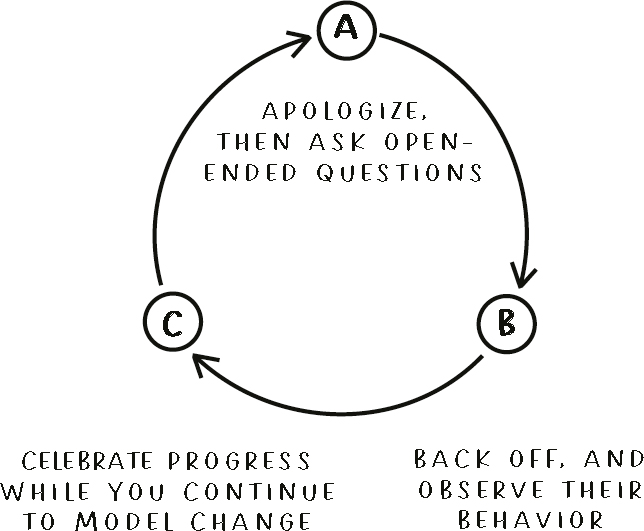
In the ABC Loop, you have three steps:
A: APOLOGIZE, then ASK open-ended questions.
B: BACK OFF, and observe their BEHAVIOR.
C: CELEBRATE progress while you continue to model the CHANGE.
Let’s take each of these three steps, one by one, and show you exactly what to do and explain with science and the Let Them Theory why this works.
1. The Ground Rules: Using the ABC Loop
If you want to use advanced techniques, you’ve got to be willing to do a little preparation.
The ABC Loop begins with a conversation that follows a proven, scientific technique. This conversation is very different from any of the conversations you have had about this issue in the past. You’re going to follow a research-backed method that is used by medical professionals in clinical settings. To ensure that this conversation is successful, you need to take it seriously, and do the prep work before you have it.
If the issue has been around for a while, you probably have a lot of pent-up frustration and emotion about it. That’s part of the problem, and it’s why you’re at a standoff. This preparation, and setting up the conversation correctly, will defuse your emotion and help you be way more effective.
The conversation needs to be in person, without any alcohol involved or time pressure to finish quickly. Do not have the conversation in a random place, or when you only have 20 minutes on the phone. It doesn’t work like that. It’s really about connecting at a deeper level with someone you care about on an issue that is bothering you.
This is also a time to show up and practice compassion and curiosity. It’s not an invitation for you to vent or complain about how frustrated and worried you are. The point is not to be “right.” The whole point is to communicate in a manner that neutralizes any tension and creates the space for positive change to happen.
The best way to do this is to come prepared to listen to the other person wholeheartedly without interrupting them.
If you follow the formula, you’ve got nothing to worry about, because you are coming from a place of love (and science). You got this.
2. The Prep Work: Using the “5 Whys” Method
Before you have the conversation, you need to get very clear about what exactly is making you so annoyed and why you want them to change. This is important because, before you can be honest with somebody else, you have to be brutally honest with YOURSELF.
Here’s how you can get to the truth with yourself. Grab a blank piece of paper, crack open a journal, or get out your Notes app.
The idea here is to rise above your emotions and get to the truth of why this bothers you so much, using a proven technique called the 5 Whys method. The 5 Whys method was created by Sakichi Toyoda, an inventor and founder of the Toyota family companies, as a way to help engineers uncover the root cause of a particular problem, and it’s now taught in business schools and engineering programs around the world.
The 5 Whys method is a formula that I’ve used in my life, business, and marriage to help me get unstuck and gain profound insights whenever I’ve faced a problem I can’t seem to solve.
In this method, you’ll ask “why?” five total times until you feel like you’ve gotten to a much deeper answer as to why this bothers you so much.
Here’s how you use the 5 Whys method:
Ask yourself: Why does this person’s behavior (or this situation) bother me so much? Think about it, and write or say your answer.
And then, ask it again:
Why does that bother you?
And then again: Why does that bother you? And then again: Why does that bother you? And then a final time: Why does that bother you?
Here’s an example of how that could look with my friend who is upset about her husband’s health. Let’s ask her:
Why does this behavior/situation bother you? It bothers me because he doesn’t seem to care about his health.
Why does that bother you? He is modeling unhealthy habits for our kids.
Why does that bother you? It’s like he’s ignoring everything important for an extra beer, 15 minutes longer at the TV, and an ice cream. . . and it’s making him unattractive.
Why does that bother you? He’s the love of my life and I think he’s being selfish. I don’t want him to have a heart attack when he could just get off the couch and exercise.
Why does that bother you? I’m terrified that I’ll lose him before I have to.
See how that works? It’s pretty obvious, 5 Whys later, that this issue is probably a lot deeper than her being mad at him. That’s exactly why it stresses her out so much. And here’s what else you need to know: Your answers will be deeply personal to you.
Give yourself permission to get to the root cause even if you discover something ugly about yourself. Having done this exercise with thousands of people, one theme that comes up a lot that is very hard to see in yourself is judgment of the other person, and how their behavior reflects badly on you (or so you think).
For example, you might answer the 5 Whys and conclude that the real reason you’re upset about someone’s drinking is because you’re embarrassed to have a son with a drinking problem. Or you’re ashamed to be married to someone who is not successful.
And whatever you learn by using the 5 Whys method is personal to you, and you do not have to share what you learn with the person. You can if you think it will help you apologize for pressuring them, but this is about you getting to the root cause of your frustration, and it will always have to do with their behavior making you feel a loss of control.
Allow yourself to be honest. When you see that it’s been about YOU all along, and your need to control, it is easier to drop the pressure and Let Them be. And that puts you into a grounded place as you go into your conversation using the ABC Loop.
Which begins with:
THE ABC LOOP
Step A: APOLOGIZE, then ASK open-ended questions.
This first step utilizes an evidence-based technique to elicit change called motivational interviewing, which I learned about from Dr. K.
Dr. K says that this is one of the only ways that is effective in helping you influence someone else’s motivation to change, and it’s the technique that he uses with his patients, who are struggling to find the motivation to change.
My favorite part of this technique is that it focuses on asking open-ended questions. The thought behind this technique is that getting the person to talk about how THEY feel will encourage them to think about the disconnect between what they want and their current behavior.
This is the opposite of pressure. Instead of thinking you know what someone should do, you’re asking open-ended questions because you’re curious about where someone stands with their behavior.
The best way to start this conversation is to first apologize. You could say something like: “I want to apologize for judging and pressuring you, and I realized I’ve never asked you how you feel about your. . .”
Health.
Grades.
Job search.
Being single.
Living situation.
Marriage.
Drinking.
Finances.
Starting with an apology sets the tone for a compassionate and supportive conversation. Really listen, lean in, and try to learn about how this person feels about the issue.
Whatever they say, just keep asking them open-ended questions that reflect back the answers they just gave you.
For my friend, it could be something like: “How are you feeling about your health right now?”
According to Dr. K, the question invites someone to really experience the tension between how they truly feel about where they are, and the fact that they are not doing anything about it.
“Each action that you take in life is individual,” he says. “And in motivational interviewing, we help people understand this principle. What we want to do is encourage people to think about their own situation.”
Then, no matter what their answer to the first question is, you’re not going to share your feelings about it. You’re just going to repeat back their answer: “So it sounds like. . .”
So it sounds like you’re feeling okay about your health?
If they answer in a one-word response—“Okay”—no problem. Just turn it into another open-ended question.
What makes you feel okay about it?
And then continue to just listen with curiosity and acceptance, and respond only with open-ended questions that repeat back what they just said.
It sounds like you’re okay with your health because you’ve been this way for a long time.
Here are some follow-up questions that Dr. K recommended for just about any topic:
How do you feel about that?
So it sounds like you’ve gotten used to it.
I mean, you’re saying you’re comfortable. It almost feels a little bit more to me like resignation. Do you feel like it’s going to take too much work to change?
What feels hard about it?
It must be incredibly frustrating to have me nagging you all the time, expecting more of you.
Can you tell me a little bit about how long you’ve felt that way?
So I hear you saying that you don’t need me to do anything?
And I need to remind you again: You are just asking questions. Your opinions are irrelevant and they are not for this conversation. The second you offer one, you’ll be pressuring the person and it will kill the effectiveness of this technique.
This technique has been proven in research and clinical settings to be very effective in getting people to admit to themselves that there is a big disconnect between what they actually want and what their current behavior is.
And that is your goal: to make them feel the tension between these things.
I have to emphasize: Do not get discouraged if all you get is one word answers, or they keep trying to change the subject. The point of this technique is not to get them to tell you the truth. It’s to create discomfort that they feel internally. They may not express it to you.
That tension is critical, because it ultimately becomes the source of their motivation to change. Seeing the disconnect between what they want and their current actions is what pushes them to eventually change for themselves.
That’s why you can’t insert yourself. You are just a vehicle for getting them to experience the disconnect, and you are doing it in a way that is loving, compassionate, and curious. You just want to know how they feel about this topic.
This conversation is a critical component for awakening their motivation to change. So Let Them talk. And Let Me listen.
Step B: BACK OFF, and observe their BEHAVIOR.
Now that you’ve apologized for your behavior and asked them the open-ended questions, you have to back off and stop pressuring them.
Don’t expect them to launch into action. They are going to need to marinate on it. This is also why it’s critical to model the change, and make it look easy and fun, while you give them the freedom to figure out for themselves why this issue matters to them.
Think of the example of the co-worker going for a walk. It might take watching someone do that for months before you feel inspired to go on a walk for yourself. And if you really think about it, every time you see your co-worker go on a walk while you work through lunch, you feel tension in your body as you sit there inside working through your lunch break. Eventually that tension transforms into the motivation that gets you out the door.
That’s why you have to give this time. It takes time for tension to transform into motivation. Let Them be.
All you can do after you’ve asked the open-ended questions is observe the behavior and stop yourself from trying to change it. If you are seeing them change, amazing. If not, Let Them be.
This takes time, particularly with somebody that you love. So back off. They need enough space, time, and distance from the conversation with you to feel like they’re not going to get an “I told you so.” Space allows them to come to the idea for themselves. Time allows the tension to transform into motivation.
Step C: CELEBRATE progress while you continue to model CHANGE.
Once you’ve asked the open-ended questions and you’ve backed off while continuing to model the behavior change, you have to celebrate any progress you see. Whenever they make the smallest move forward, celebrate it.
Dr. Sharot’s research says that immediate positive compliments are a key driver to influencing behavior change. For example, if your spouse one day heads down to the basement and hops on the Peloton, that’s amazing. When they come back upstairs, give them a hug. Tell them you’re proud of them.
Dr. Sharot says that one of the most effective things you can do is tell them how attractive they look, or give them a kiss on the cheek, as soon as they are done working out or doing what you want them to do.
It sounds cheesy, but it actually works.
It’s Simple. People Want to Feel Good.
According to the research, immediate positive rewards after someone does something hard will boost their intrinsic motivation or desire to do it again. When you acknowledge their effort, it acts like fuel to keep them going.
The hard thing gets fused with something really pleasurable: the reward that you are providing. And remember what Dr. K taught you about the human brain: We are wired to move toward what feels pleasurable, easy, and fun.
The more my friend compliments, hugs, and admires her husband post-workout, the faster her husband will connect working out with compliments, desire, and the fact that his wife thinks he looks damn good. Her positive attention becomes the pleasure he moves toward, and what has been missing this entire time.
This isn’t just common sense. It’s neuroscience. You learned that humans are wired to move toward immediate positive benefits. The good things. The celebrations. So often, we approach change with negative reinforcements, threats, pressure, and fear, when the real success lies in being accepting, compassionate, and showing your support in a genuine and effective way.
It makes sense, doesn’t it? Of course it does.
Adults only do what they feel like doing. Your power is in your positive influence. Let Them be. And Let Me use the science to inspire change. Let Them helps you rise above the emotions and broken dynamics to strengthen your connection, while Let Me influences positive behavior change in the people you love.
They may change immediately. They may change in a week. They may change in several months. It may take years. Maybe they might never change.
And that’s okay too.
Later in the book, we’ll discuss what happens when you’ve tried the ABC Loop, you’ve backed off for six months, and there’s still no positive change. When this happens, you’ll need to decide if this is a deal breaker or not. It’s not fair to stay in a relationship where you are chronically complaining about someone else. You hold the power, always, to make something better or to learn how to accept things as they are.
The most important change in any relationship is the one that you can control: yours. You change how you showed up. You stop pressuring the person that you love and become more loving.
That’s what makes you influential.
And in the process, if you do it right, you don’t just reduce the friction between you and the person that you love. You also make the relationship much better along the way.
But what about when the stakes are really high, and it’s not just a matter of someone getting in better shape, or being a little more motivated at work, or being more proactive and helpful around the house?
What if the person you love is spiraling? Do you just Let Them keep drinking? Do you just Let Them lie in bed with depression? Do you just Let Them fall apart?
I saw these questions over and over again while researching this book. In the next chapter, you’ll learn an entirely new approach to supporting someone who is struggling, using the Let Them Theory and the latest expert research.
But first, let’s summarize how to motivate other people to change. Yes, you want people in your life to change, but pressuring them only creates resistance to it.
The Let Them Theory encourages you to accept others, focus on your own growth, and inspire change through positive influence instead of pressure.
- Problem: Pressure doesn’t create change; it creates resistance to it. You are acting with the best of intentions, but it is yielding the worst result. Every time you pressure someone, it pushes them away. You are not only straining your relationships, you are fighting against the wiring inside someone’s brain and body. You think the tension and frustration are due to the fact that the other person won’t do as you wish. You are wrong. The tension and disconnection are being created by your pressure.
- Truth: Adults only change when they feel like changing. Human beings have a hardwired survival instinct to be in control of every aspect of their life. Anytime someone feels like they are being forced to do something, they will fight back—and you will find yourself locked in a battle for control. What human beings want is to feel acceptance and love. They need to be in control of their own thoughts, actions, and decisions. Your power is in your influence.
- Solution: Using the Let Them Theory, you will leverage the laws of influence to unlock someone else’s intrinsic motivation to change for themselves. By using the ABC Loop to ask open-ended questions, model behavior change, and celebrate progress, you use your power to change other people. The key piece of this is creating the space for someone else to believe the change is their idea. Not yours.
When you say Let Them, you are accepting other people as they are, removing tension and pressure, and letting them have control over the way they live their life. When you say Let Me, you use neuroscience to your advantage and unlock your power of influence to motivate someone else to change.
Let adults be adults, and let your influence inspire them to change.