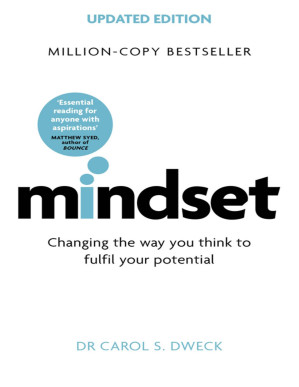
Mindset: Changing The Way You Think To Fulfil Your Potential
Carol S. Dweck
Description
What if the way you think about your abilities influences how far you can go? Why do some people view challenges as opportunities to learn, while others avoid situations where they might fail? In Mindset: Changing The Way You Think To Fulfil Your Potential, renowned psychologist Carol S. Dweck explores how our beliefs about intelligence, talent, and personal abilities can shape our behavior, motivation, and approach to success.
Drawing on decades of psychological research, Dweck introduces the difference between a fixed mindset and a growth mindset. A fixed mindset assumes that abilities are largely unchangeable, while a growth mindset emphasizes the possibility of developing abilities through learning, practice, effective strategies, and feedback.
The book explains how these mindsets can influence education, careers, relationships, leadership, and personal development. Through research, examples, and practical insights, Dweck encourages readers to reconsider how they respond to failure, criticism, and difficult experiences.
Whether you want to improve your professional skills, become a more effective teacher, help children develop confidence, or pursue personal goals, this book provides a useful framework for understanding the relationship between beliefs, learning, and achievement.
What Will You Learn from This Book?
By reading Mindset: Changing The Way You Think To Fulfil Your Potential, you will explore important ideas that can help you approach challenges and personal development more constructively.
- Understand fixed and growth mindsets: Discover the differences between believing abilities are fixed and believing they can be developed.
- Recognize limiting beliefs: Identify thought patterns that may discourage you from trying new things or learning from mistakes.
- Develop resilience: Learn how to respond to setbacks with reflection, persistence, and a willingness to improve.
- Embrace challenges: Understand why difficult tasks can provide opportunities to develop skills and knowledge.
- Learn from criticism: Explore how constructive feedback can help you identify weaknesses and improve your performance.
- Value effort and effective strategies: Recognize that effort is important when combined with appropriate methods, guidance, and learning.
- Support lifelong learning: Develop a more open approach to acquiring new skills and adapting to change.
- Apply mindset principles in education and work: Discover how beliefs about ability can influence teaching, leadership, teamwork, and professional development.
Why Should You Read This Book?
The way you interpret success and failure can influence your decisions, motivation, and willingness to pursue difficult goals. If you often doubt your abilities, avoid challenges, or feel discouraged by mistakes, Mindset can help you examine the beliefs behind these reactions.
Here are five reasons to read this book.
1. Change the way you approach challenges
Learn to see difficult experiences as opportunities to develop skills instead of treating every struggle as evidence that you lack ability.
2. Build a healthier relationship with failure
Understand how mistakes can provide useful information about what needs to change and how you can improve.
3. Strengthen your motivation to learn
Explore how curiosity, practice, feedback, and effective strategies can support long-term development.
4. Improve your approach to education and leadership
Discover how teachers, parents, and managers can encourage learning and improvement without labeling people as naturally talented or incapable.
5. Develop a foundation for personal growth
Use the book's concepts to reflect on your habits, challenge unhelpful assumptions, and identify areas where you want to develop new abilities.
What Is This Book About?
Mindset: Changing The Way You Think To Fulfil Your Potential is a psychology and personal development book by Carol S. Dweck, a researcher known for her work on motivation, achievement, and beliefs about ability.
The book explores how a person's mindset can affect learning, performance, and responses to challenges. Dweck explains that people with a fixed mindset tend to view abilities as relatively unchangeable, while people with a growth mindset are more likely to believe that abilities can be developed through learning and experience.
These beliefs can influence how people respond to academic difficulties, workplace setbacks, competition, relationships, and personal goals. The book also examines how parents, educators, coaches, and leaders can foster environments that support learning and improvement.
One of its central messages is that potential is not simply a matter of what you can do today. It is also connected to what you are willing to learn, how you respond to feedback, and the strategies you use to develop your abilities.
Importantly, a growth mindset does not mean that effort alone guarantees success or that every limitation can be overcome. Meaningful improvement also depends on effective strategies, resources, support, and the circumstances in which learning takes place.
Who Should Read This Book?
This book is particularly useful for:
- Students: Those who want to approach academic challenges with greater confidence and persistence.
- Teachers and educators: Professionals interested in encouraging curiosity, learning, and constructive responses to mistakes.
- Parents: Readers who want to support children's confidence and development without creating fear of failure.
- Professionals: People seeking to improve their skills, adapt to change, and learn from workplace feedback.
- Managers and leaders: Individuals interested in building environments that value development and continuous improvement.
- Personal development enthusiasts: Anyone who wants to examine limiting beliefs and adopt a more constructive approach to learning.
Unlock Your Potential Through Continuous Learning
Mindset: Changing The Way You Think To Fulfil Your Potential offers a thought-provoking perspective on how beliefs about ability can shape the way we approach life's opportunities and challenges. By understanding fixed and growth mindsets, readers can begin recognizing unhelpful thought patterns and developing more constructive responses to mistakes, criticism, and difficult goals.
If you want to improve your approach to learning, strengthen your resilience, and become more open to personal development, this book is a valuable resource to explore. Discover how changing the way you think about your abilities can help you pursue meaningful progress and make the most of your potential.psy
Language
English
Publisher
Random House
Year Published
2017
Categories
Personal development / Positive thinking, Psychology, Self-Help